Union Pacific (UNP): CFO Hamann to retire in early 2027 as Norfolk Southern merger review continues
Union Pacific said on 16 October that Chief Financial Officer Jennifer Hamann will retire in early 2027 after 35 years with the railroad. No successor has been named. The news comes six days before third-quarter results and while US regulators review Union Pacific's proposed purchase of Norfolk Southern.
What happened
On 16 October 2026 Union Pacific Corporation (NYSE: UNP), one of the largest US freight railroads, filed an 8-K (the form US companies use to report important events) under Item 5.02, which covers changes in senior officers. It said Jennifer L. Hamann, Executive Vice President and Chief Financial Officer, plans to retire in early 2027 and will keep her current responsibilities until then. The company said it will announce further details about the transition later and did not name a successor.
The accompanying press release says Hamann joined Union Pacific in 1992 on the audit staff, held roles in finance, human resources, marketing and sales, investor relations and corporate audit, and became CFO in January 2020, the first woman to hold the job. It also lists her board seats at TTX Company, Grupo Ferroviario Mexicano and Steel Dynamics. Reuters, in a report carried by US radio sites, adds that Union Pacific agreed last year to buy Norfolk Southern in an $85 billion deal that the transport regulator is still evaluating. In the release, Hamann said she remains an "ardent supporter of the merger".
The numbers, explained
A CFO change is not a financial result, so the numbers that matter are the ones she leaves behind. In the second quarter of 2026, reported on 23 July, Union Pacific had operating revenue of $6,864m against $6,154m a year earlier, up $710m or 11.5% (710 divided by 6,154, our calculation; the company rounds this to 12%). Operating income, the profit left after running costs but before interest and tax, rose from $2,525m to $2,763m, up 9.4%. Net income rose from $1,876m to $1,993m, up 6.2%, and diluted profit per share rose from $3.15 to $3.36. All figures are in US dollars under US accounting rules (GAAP) unless marked adjusted.
Railroads watch the operating ratio: operating expenses divided by operating revenue, where lower is better. Expenses were $4,101m, so the ratio was 59.7% (4,101 divided by 6,864), meaning about 40 cents of each revenue dollar was left as operating income (2,763 divided by 6,864 is 40.3%). A year earlier it was 59.0% (3,629 divided by 6,154), so efficiency slipped by about 0.7 points, matching the company's stated 70 basis points (a basis point is one hundredth of a percentage point). The company says higher fuel prices cost 120 basis points of that. Its adjusted figures, which strip out items it treats as one-off, were EPS of $3.41 and an operating ratio of 59.2%; those are company-defined measures, not GAAP.
Revenue grew faster than profit largely because of fuel. Freight revenue (money from moving goods) rose 12% to $6,518m, but excluding the fuel surcharge that customers pay to cover fuel costs it rose only 4%, per the company. Because the surcharge mostly passes fuel costs on, it lifts revenue without adding much profit, which is why a 12% revenue rise produced a 6% profit rise. The company also raised its 2026 outlook to high-single-digit growth in reported profit per share and kept its $3.3 billion capital plan. That outlook is the company's own forecast, not our estimate.
Why it matters
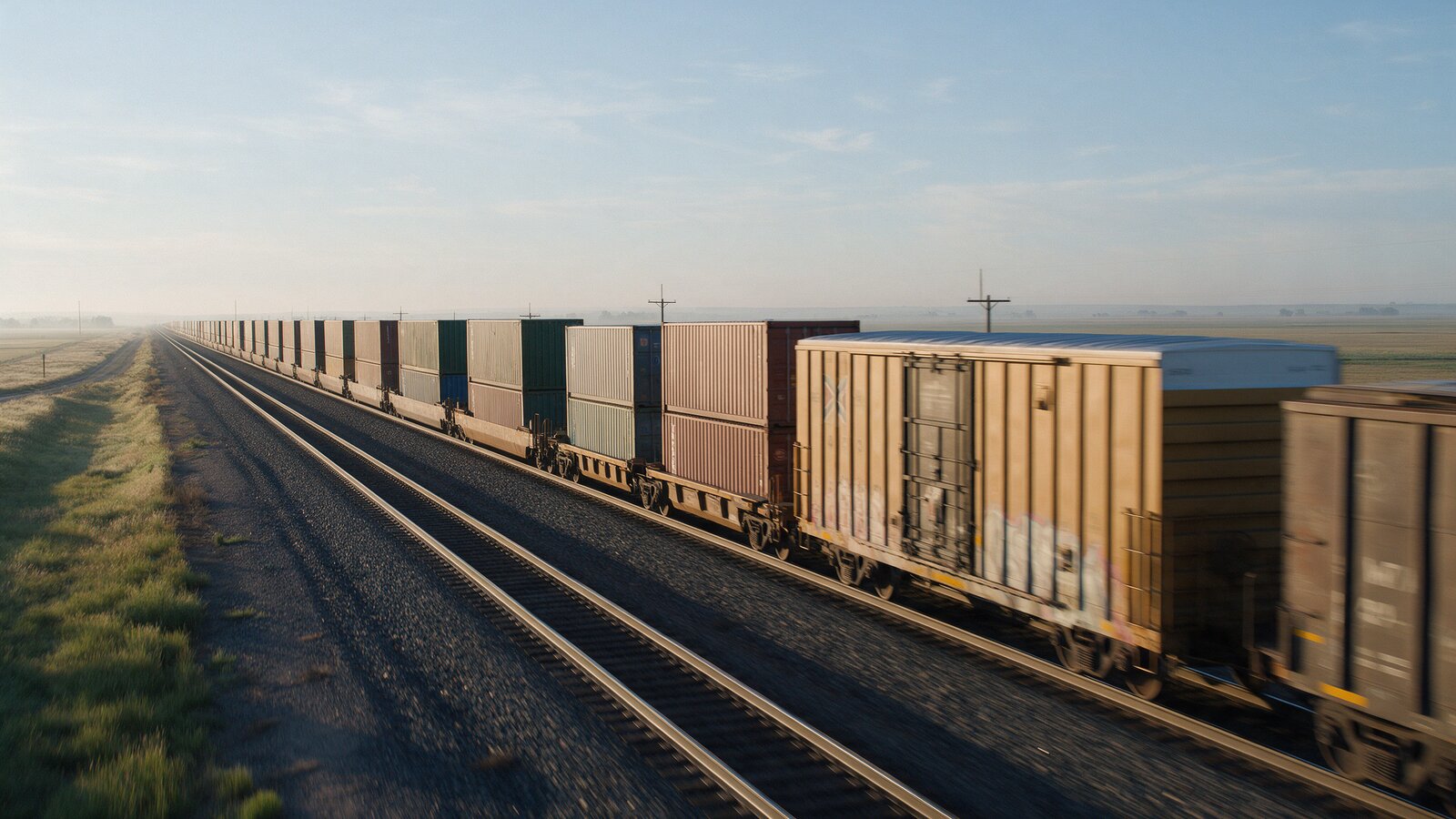
Union Pacific earns money by hauling freight such as containers, grain, chemicals and cars across 23 western states, and by keeping costs low relative to what it charges. A CFO oversees that cost discipline, the capital plan, borrowing and the messages sent to investors. Hamann has held the post through the pandemic and the start of the merger process, so a handover mid-deal matters for continuity, although she is staying in role until early 2027 and the company has given no sign that its financial plans have changed.
The merger is the larger story. Union Pacific and Norfolk Southern would form one railroad running coast to coast. The US Surface Transportation Board (STB), which approves rail mergers, accepted the revised application on 28 May 2026, paused the review while the companies added information, and restarted it on 18 August 2026, according to law firm Thompson Hine. The STB stressed this was procedural, not a ruling on the merits. For customers, rivals and the sector, the outcome decides whether a single railroad can run from coast to coast, which is why the schedule invites comments from shippers and other interested parties. Union Pacific's own filings warn that approval could come with conditions that change the expected benefits.
What to watch next
Union Pacific has scheduled its third-quarter 2026 results for Thursday 22 October 2026 at 7:45 a.m. Eastern time, with a call at 8:45 a.m. Under the STB timetable that Union Pacific published on 21 August 2026, comments and protests on the merger are due on 18 November 2026, preliminary comments from the Justice and Transportation departments on 3 December 2026, and responses on 16 February 2027. A public hearing is set for after 29 March 2027, final briefs are due on 28 May 2027, and the STB must then decide within 90 days of the record closing. The date of a CFO successor announcement has not been given. We make no forecast about any of these.
- Operating ratio: operating expenses divided by operating revenue; lower means the railroad keeps more of each sales dollar.
- 8-K: the form US public companies file to report significant events promptly.
- Fuel surcharge: a fee charged to customers to cover changes in fuel costs.
- Basis point: one hundredth of a percentage point; 70 basis points is 0.7 points.
Sources
- Union Pacific 8-K, 16 Oct 2026 (SEC)
- Union Pacific CFO retirement press release (SEC exhibit 99.1)
- Union Pacific CFO Jennifer Hamann to retire (Business Wire via Finviz)
- Union Pacific CFO Jennifer Hamann to retire in early 2027 (Reuters via WHBL)
- Union Pacific Q2 2026 earnings release (SEC 8-K, 23 Jul 2026)
- Union Pacific Q2 2026 summary (Quartr)
- Timeline Set for UP-NS Merger Decision (Union Pacific, 21 Aug 2026)
- STB Lifts Abeyance in UP-NS Merger and Sets Procedural Schedule (Thompson Hine)
More on Union Pacific (UNP) · Industrials takes
For information only. Not financial advice. See our disclaimer and editorial standards. Spotted an error? Tell us.