RTX (RTX): adjusted profit per share rises 33% to $2.26, but $0.25 is a one-off tariff cost recovery
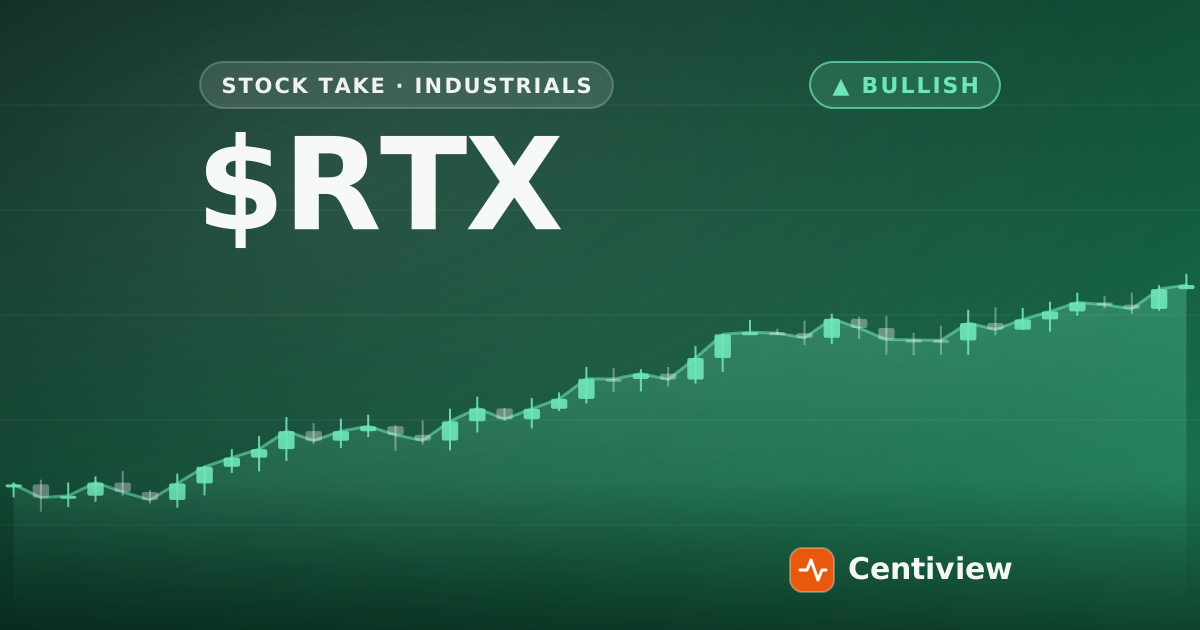
RTX, the US maker of jet engines, aircraft systems and missiles, reported third-quarter sales of $25.0bn, up 11% on a year ago, and adjusted profit of $2.26 per share, up 33%. It raised its 2026 forecasts for sales, profit and cash flow. About $0.25 of the quarter's profit per share came from the recovery of tariff costs, which is a one-off.
What happened
On 20 October 2026 RTX published results for the three months to 30 September. Sales were $24,965m (about $25.0bn), against $22,478m a year earlier. RTX has three divisions: Collins Aerospace, which makes aircraft systems such as cockpit electronics and seats; Pratt & Whitney, which makes jet engines; and Raytheon, which makes missiles and air-defence systems. All three grew. The company said it was awarded multi-year production contracts for the Tomahawk and AMRAAM missiles during the quarter, and that its backlog, the value of orders received but not yet delivered, reached a record $340bn.
Chief executive Chris Calio said demand "remains robust", with over $81bn of new commercial and defence awards in the quarter. RTX also raised its full-year 2026 forecast again. Adjusted sales are now expected at $97.0bn to $97.5bn (previously $95.0bn to $96.0bn), adjusted profit per share at $7.65 to $7.75 (previously $7.10 to $7.25) and free cash flow, the cash left after running costs and spending on equipment, at $9.0bn to $9.2bn (previously $8.50bn to $8.75bn). These are the company's own forecasts, not ours. Investing.com reported that analysts had expected profit of $1.78 per share and sales of about $24.1bn.
The numbers, explained
Start with sales: $24,965m against $22,478m is a rise of $2,487m, or 11.1%. Reported (GAAP, the standard accounting measure) profit was $2,583m, or $1.89 per share, up 35% from $1,918m, or $1.41. The adjusted figure, which strips out items such as the amortisation of assets bought in acquisitions ($0.26 per share) and restructuring and one-off items ($0.11), was $2.26 per share against $1.70, a rise of $0.56 or 32.9%. Adjusted profit in total was $3,091m against $2,311m, up 33.7%. Against the second quarter's $1.89 adjusted figure, the quarter is $0.37 higher, up 19.6%.
The important caveat is the tariff item. RTX says $0.25 of the $2.26 came from "IEEPA cost recovery", meaning it recovered costs linked to tariffs imposed under the International Emergency Economic Powers Act; the release says this added about $0.4bn to the divisions' operating profit. Take that out and adjusted profit would be about $2.01 per share, which is our arithmetic, not a company figure. That would still be 18.2% above last year's $1.70 (0.31 divided by 1.70), and $0.23 above the $1.78 analysts expected, though we do not know whether those estimates included any recovery. The division profits tell the same story: Collins Aerospace's adjusted operating profit was $1,788m against $1,194m (up 49.7%), including about $250m of recovery; Pratt & Whitney's was $968m against $751m (up 28.9%), including about $160m.
Cash is where the picture is weaker. Operating cash flow was $2,868m against $4,639m a year ago, down 38.2%, and free cash flow was $2,119m against $4,025m, down 47.4% (capital spending was about $749m). The release does not set out the cause in the text we read, so we do not offer one. Pratt & Whitney's reported operating profit of $608m, down 19%, was lower than the adjusted $968m because it included a $363m charge relating to a customer bankruptcy. Backlog rose from $289bn at the end of June to $340bn, up $51bn or 17.6%: defence orders went from $119bn to $164bn (up 37.8%) while commercial went from $170bn to $176bn.
Why it matters
RTX makes money in two main ways. It sells new equipment, such as engines and aircraft systems, to aircraft builders and governments, and it sells spare parts, repairs and upgrades for equipment already in service, known as the aftermarket. This quarter Pratt & Whitney's commercial aftermarket sales rose 21% while its sales of new commercial engines fell 5%, and Collins' new commercial equipment sales rose 23%. At Raytheon, sales rose 14% to $8,031m, driven by Patriot, Standard Missile and Tomahawk systems, with a profit margin (the share of each sales dollar kept as operating profit) of 14.1% against 12.2%.
For airlines and governments, the numbers show a supplier with a very large order book, which gives it a view of work years ahead. For rivals and the wider sector, the mix matters: defence backlog grew faster than commercial this quarter, and a meaningful part of the profit jump was a one-off recovery rather than higher underlying earnings. Pratt & Whitney's margin, excluding about $160m of recovery, would be roughly 8.8% (808 divided by 9,231) against 8.9% a year ago, which is our estimate and suggests its underlying margin was about flat.
What to watch next
RTX held its results call at 8:30 a.m. ET on 20 October 2026. It has not, in the documents we read, given a date for its fourth-quarter results; those will carry the final 2026 numbers against the raised forecast of $7.65 to $7.75 adjusted profit per share. The full quarterly report (Form 10-Q) filed with the SEC should give more detail on the tariff recovery, the customer bankruptcy charge and the cash flow. Checkable points are whether free cash flow lands within the $9.0bn to $9.2bn forecast and whether backlog stays at or above $340bn.
- Adjusted figures: results with items such as acquisition accounting and one-offs taken out
- Backlog: the value of orders received but not yet delivered
- Aftermarket: spare parts, repairs and upgrades for equipment already in use
- Free cash flow: operating cash flow less capital spending (RTX's definition)
Sources
More on RTX (RTX) · Industrials takes
For information only. Not financial advice. See our disclaimer and editorial standards. Spotted an error? Tell us.