Philip Morris (PM): record Q3 sales and an 8.8% dividend rise, but only a currency-driven lift to its 2026 profit forecast
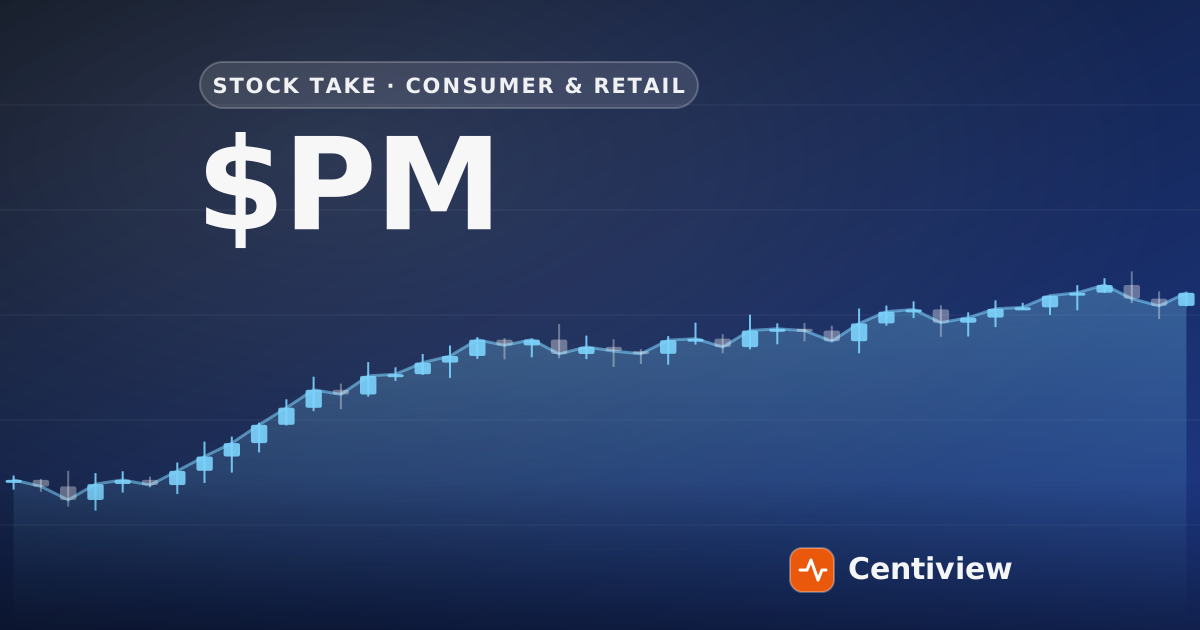
Philip Morris International, the maker of Marlboro cigarettes, IQOS heated-tobacco devices and ZYN nicotine pouches, reported third-quarter sales of $11.4bn, up 5.5%, and adjusted profit per share of $2.36, up 5.4%. It raised its quarterly dividend 8.8% to $1.60 per share, but said the lift to its full-year profit forecast came only from currency.
What happened
On 21 October 2026 Philip Morris International (PMI) published its third-quarter results in a release filed with the US Securities and Exchange Commission (SEC). Sales, which the company calls net revenues, reached $11,438m, a record for a quarter, as did gross profit (sales minus the direct cost of making products) and operating income (profit from running the business, before interest and tax). The company shipped 206.2 billion cigarettes and smoke-free units, up 0.6%. Smoke-free products, meaning heated tobacco, nicotine pouches and e-vapor, grew 2.7% in volume, while cigarette volumes were flat. Smoke-free products made up more than 40% of sales.
The same release raised the regular quarterly dividend by 8.8%, from $1.47 to $1.60 per share, or $6.40 over a year. PMI also updated its 2026 forecast for adjusted profit per share to a range of $8.29 to $8.44. The company describes this as an update "for currency only": currency is expected to add $0.18 per share to 2026 profit, up from $0.15 in its July forecast. It also said its operating income growth is now more likely to land in the middle or lower half of its 7% to 9% range, citing higher costs linked to Middle East tensions and heavier US spending on ZYN.
The numbers, explained
Sales rose from $10,845m a year earlier to $11,438m, an increase of $593m, or 5.5% (593 / 10,845). Price added $739m, which is 6.8% of last year's sales (739 / 10,845), while changes in volume and product mix added only $36m and currency took away $155m. "Organic" growth, which strips out currency and acquisitions, was 7.1%. In short, most of the growth came from charging more per pack rather than selling more packs. International cigarettes, the largest segment at $6,725m of sales, grew 6.5% (409 / 6,316) with prices up 8.9%. The company noted that a restructuring of distribution terms in some markets helped, and it does not expect that to repeat at the same level.
Profit tells two stories. Reported (GAAP, meaning US accounting standard) diluted profit per share fell 4.9%, from $2.23 to $2.12 (0.11 / 2.23). The company says this was mainly a non-cash charge from changing values of investments it holds in other companies' shares. Adjusted profit per share, the company's own measure that removes one-off and non-cash items, rose from $2.24 to $2.36, or 5.4% (0.12 / 2.24). Our check of the bridge: $2.12 + $0.13 amortisation of acquired intangibles (the gradual write-off of purchased brands) + $0.06 investment value change + $0.01 tax + $0.04 Dutch pension buy-out loss = $2.36. Adjusted operating income was $5,117m against $4,670m, up 9.6%, and its margin rose from 43.1% to 44.7% (our working).
In the United States, sales grew 22.7% to $845m, helped by comparison with a promotion last year, and ZYN shipments rose 4.2% to 3.2 billion pouches. Yet operating income for the US segment fell 3.3% as PMI spent more to support ZYN. Analyst expectations, which are third-party estimates and not facts, were adjusted profit per share of about $2.30 and sales of about $11.32bn, so PMI came in ahead on both. Over nine months, adjusted profit per share was $6.52, so the forecast range implies roughly $1.77 to $1.92 in the fourth quarter (8.29 - 6.52 and 8.44 - 6.52), our own arithmetic.
Why it matters
PMI earns money in two ways. The older business sells cigarettes, where fewer people smoke each year but the company keeps raising prices, which produces large and steady cash. The newer business sells smoke-free alternatives, which PMI says it needs to replace that decline over time. This quarter shows both at work: price rises in cigarettes did most of the heavy lifting, while smoke-free products grew in volume. IQOS heated-tobacco units rose 1.5% to 41.5 billion, and PMI estimates its share of the heated-tobacco market at about three-quarters.
For shareholders, the dividend rise is a cash payment decision, and the company said it plans no share buybacks in 2026 while it works to lower debt towards about 2.0 times its adjusted EBITDA (earnings before interest, tax, depreciation and amortisation). PMI's "outlook" statements, including 5% to 7% organic sales growth for 2026, are company forecasts, not results.
What to watch next
PMI said its quarterly report on Form 10-Q, the longer filing with full accounts, will follow "in the coming days". In the fourth quarter it plans to raise spending on ZYN, including a wider advertising campaign and a switch of most flagship ZYN products to 20-pouch cans from 15. Japan, a key heated-tobacco market, saw a second excise-driven price rise of 20 yen per pack on 1 October, to which the company said consumers are still adjusting. The release did not give a date for fourth-quarter and full-year results, so we do not state one. We also leave out the share-price move on the day because sources reported different figures.
- Adjusted profit per share: PMI's own measure, excluding one-off and non-cash items; not a GAAP figure
- Organic growth: growth excluding currency moves and acquisitions or sales of businesses
- Smoke-free products: heated tobacco, nicotine pouches and e-vapor, as PMI defines them
- Heated tobacco units (HTU): sticks heated rather than burned, used with IQOS devices
Sources
- Philip Morris International Q3 2026 results release, Form 8-K Exhibit 99.1 (SEC)
- Philip Morris International Q2 2026 results release, Form 8-K Exhibit 99.1 (SEC)
- Philip Morris beats estimates but stock dips on guidance (Investing.com)
- Philip Morris International releases earnings results, beats estimates by $0.06 EPS (MarketBeat)
- Philip Morris Q3 earnings and revenues surpass estimates (Yahoo Finance)
More on Philip Morris (PM) · Consumer & Retail takes
For information only. Not financial advice. See our disclaimer and editorial standards. Spotted an error? Tell us.