Hasbro (HAS): sales up 15% to $1.6bn as Magic: The Gathering tops $600m in a quarter and the 2026 outlook is raised
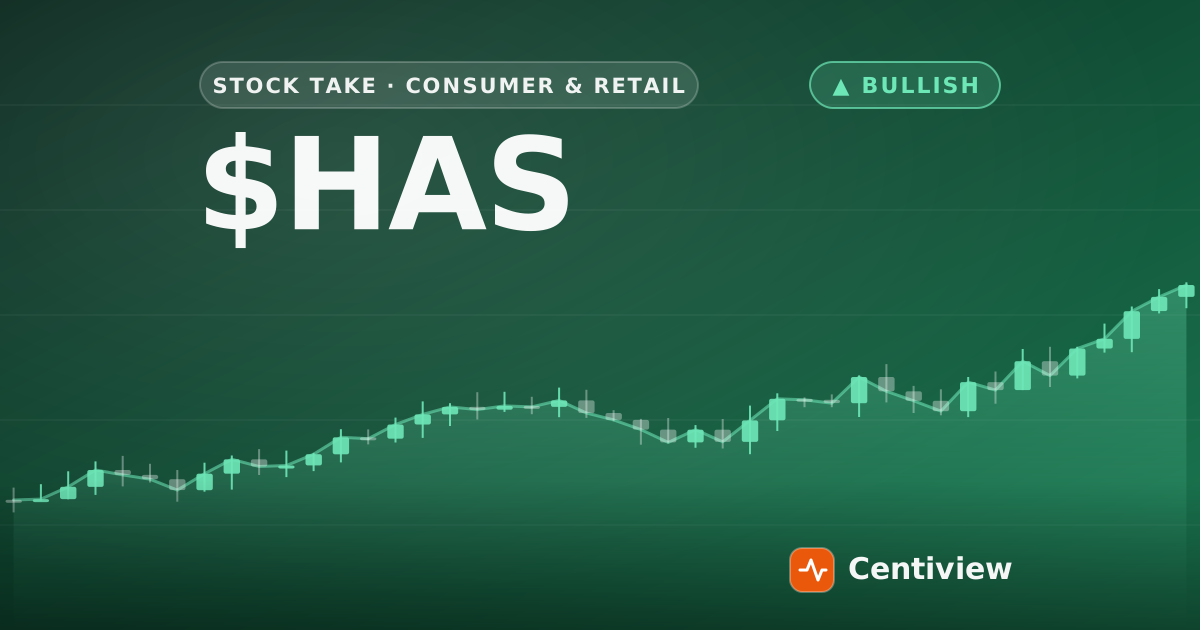
Hasbro, the toy and games company behind Monopoly, Transformers and Magic: The Gathering, reported third-quarter sales of $1.6bn, up 15% from a year ago, and profit before one-off items of $2.90 per share, up from $1.68. Its card game Magic passed $600m of quarterly sales for the first time, and the company raised its forecast for the full year.
What happened
On 20 October 2026 Hasbro published results for the three months to 27 September in a release filed with the US Securities and Exchange Commission (SEC). Total sales, which the company calls net revenues, were $1,595.3m against $1,387.5m a year earlier. The company has three parts: Wizards of the Coast and Digital Gaming, which makes Magic and licenses video games; Consumer Products, the toys and board games; and Entertainment, its film and television arm. Wizards grew fastest, with sales up about 31%, while Consumer Products grew about 4%.
Hasbro also raised its forecast for 2026 and said it was doubling its share repurchase target for the year, meaning it plans to spend more on buying its own shares. The release gave no dollar figure for the new target, but a transcript of the call published by Investing.com says it rose from $200m to $400m. After the results the shares rose; reports differ on the size, from about 5% in early trading to about 11% later in the day, so we treat the move as preliminary. Hasbro said the figures include about $55m of refunds of tariffs, the import taxes it had paid earlier.
The numbers, explained
Sales by part, this quarter against a year ago: Wizards and Digital Gaming $747.2m against $572.0m (up 30.6%, our working: 747.2 / 572.0 = 1.306); Consumer Products $827.9m against $796.9m (up 3.9%); Entertainment $20.2m against $18.6m (up 8.6%). The three add up to $1,595.3m, and the total is up 15.0% (1,595.3 / 1,387.5). Magic itself, which sits inside Wizards, brought in $616.1m against $459.4m, up 34.1%, or about 38.6% of all Hasbro sales. Wizards kept 49.2% of its sales as operating profit ($367.4m / $747.2m), a far higher margin than the toy business.
Profit comes in two versions. Under GAAP, the standard accounting rules, operating profit, what is left after the costs of running the business, was $517.3m against $341.1m, up 51.7%. That is a margin of 32.4% against 24.6% (517.3 / 1,595.3 and 341.1 / 1,387.5). Net earnings attributable to Hasbro were $394.5m against $233.2m, up 69.2%, or $2.77 per diluted share against $1.64 (up 68.9%). The company's adjusted figures, which remove items it treats as one-off, were $2.90 per share against $1.68 (up 72.6%) and adjusted operating profit of $541.2m against $355.6m (up 52.2%). Adjusted EBITDA, a measure of operating profit before depreciation and amortisation (the spreading of past spending over several years), was $604.5m against $412.9m, up 46.4%.
The tariff refunds matter for comparing profit. Of the $55m, $48m was booked in Consumer Products and $7m in Wizards. As a rough working, adjusted operating profit without the full $55m would be about $486m ($541.2m minus $55m), still up about 37% on last year's $355.6m. This assumes last year's figure had no similar item; the release does not say. Analysts, according to an Investing.com article that does not name its data source, had expected adjusted profit of about $1.86 per share and sales of about $1.48bn; these are estimates, not company figures. Sales of $1.59bn would be about 7.4% above that estimate.
Why it matters
Hasbro makes money in two quite different ways. Toys and board games are sold to shops, depend on the Christmas season and on film and television licences such as Marvel, and carry a lower profit margin: Consumer Products made $173.8m of operating profit on $827.9m of sales, a 21.0% margin, including the tariff refund. Magic is a collectible card game sold in packs and boxes, and it keeps coming back as players buy new sets. This quarter's growth was linked by the company to new sets including The Hobbit and Reality Fracture. For game shops, Magic is a reason for customers to return; for rival toy makers, it shows how much more profitable a game with a loyal community can be than a toy line.
Monopoly Go!, a mobile game that carries the Monopoly brand, added $41m of sales in the quarter and $127m so far this year. The company raised its 2026 forecast: sales growth of 7% to 9% at constant exchange rates (previously 5% to 7%), an adjusted operating margin of 27% to 28% (previously 25% to 26%), and adjusted EBITDA of $1.575bn to $1.625bn (previously $1.45bn to $1.50bn). These are the company's own forecasts, not facts. In the Investing.com transcript summary, management said it expects Wizards sales to fall in the fourth quarter because about $40m of sales moved into the third, and called that timing rather than weaker demand; that is management's characterisation, which we have not independently verified.
What to watch next
Hasbro will pay a quarterly dividend of $0.70 per share on 2 December 2026 to shareholders on its register on 18 November 2026. The release did not give the date of fourth-quarter results, so we do not state one. When they arrive, readers can compare the full-year numbers with the forecast ranges above, check whether Wizards sales fall in the fourth quarter as management said they would, and see how large the share repurchases are. Hasbro had spent $149.3m on buying back shares in the first nine months, so reaching a $400m target would need a much larger fourth quarter. Cash at the end of the quarter was $850.7m.
- GAAP: the standard accounting rules companies must report under
- Adjusted: the company's own version of profit, excluding items it treats as one-off
- Constant currency: growth measured as if exchange rates had not moved
- Share repurchase: a company buying back its own shares from investors
Sources
More on Hasbro (HAS) · Consumer & Retail takes
For information only. Not financial advice. See our disclaimer and editorial standards. Spotted an error? Tell us.