Halma (HLMA): First-half sales up 16% to £1.43bn as one data-centre customer reaches 22% of sales
Halma, the FTSE 100 group that owns a family of specialist companies making safety, environmental and medical technology, said sales rose 15.8% to a record £1.43bn in the six months to 30 September 2026, and adjusted profit from running the business rose 22.5% to £345.4m. It kept its full-year forecast and raised its interim dividend 7%. One customer, a large data-centre operator buying optical switches, now accounts for 22% of group sales.
What happened
On 19 November 2026 Halma published results for the first half of its financial year to 31 March 2027. Figures are in pounds sterling and compare with the same six months a year earlier. Revenue was £1,433.2m, up from £1,237.4m. Group chief executive Marc Ronchetti called it "an excellent first half" and said the company is "well placed to deliver our existing guidance". Halma also said it spent a record £516m on six acquisitions during the half, completed two more for about £55m after 30 September, and sold three businesses. The board declared an interim dividend of 10.30p a share, up from 9.63p, to be paid on 29 January 2027 to shareholders on the register on 18 December 2026.
The numbers, explained
Revenue grew by £195.8m (1,433.2 minus 1,237.4), or 15.8%. Organic growth, which strips out acquisitions, disposals and currency moves to show how the existing businesses did, was 12.3%, or 13.1% if you leave out a one-off licence payment booked in China in the first half of last year. Price rises added only 1% to 2%, so most growth came from selling more. All three divisions grew. Environmental & Analysis, which includes the photonics business, rose 20.1% to £586.2m, about 41% of the total. Safety, which includes fire detection and worker-safety equipment, rose 14.7% to £531.4m, and Healthcare rose 10.2% to £316.0m. US sales rose 18.2% to £698.6m, almost half the group.
Adjusted EBIT, Halma's preferred measure of profit from running the business before interest and tax, leaves out £38.2m of items such as the write-down of assets bought with acquired companies. It rose £63.4m, or 22.5%, to £345.4m. That means Halma kept about 24.1p of every £1 of sales as profit, against 22.8p a year ago (345.4 divided by 1,433.2, and 282.0 divided by 1,237.4). Under standard accounting, profit before tax rose 19.5% to £289.0m from £241.8m, and profit per share rose 17.8% to 58.22p. Adjusted profit per share rose 19.7% to 66.24p from 55.32p. Net debt was 1.26 times a year's adjusted EBITDA (profit before interest, tax and write-downs), up from 1.16 times in March because of the acquisition spending.
Why it matters
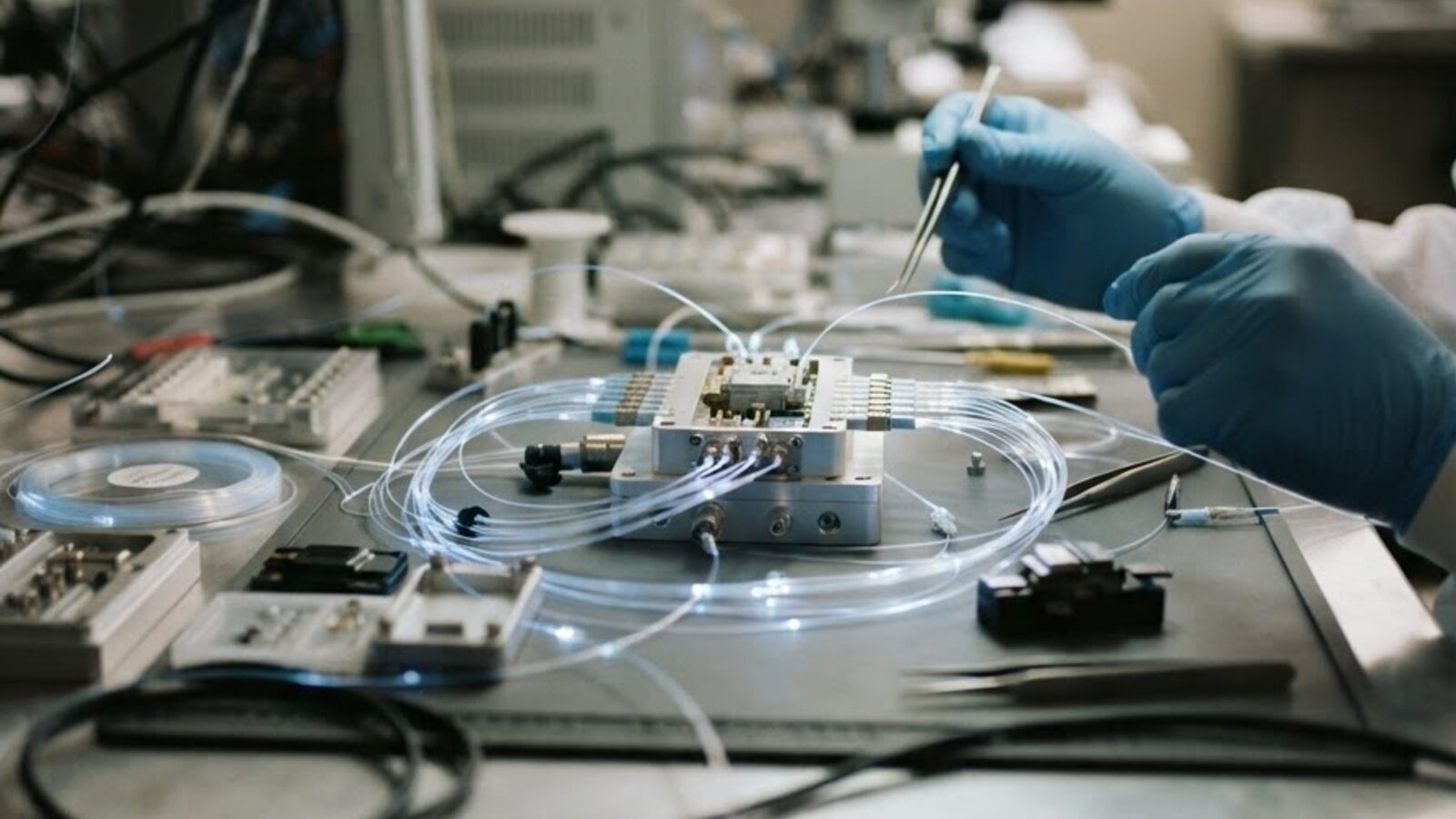
Halma makes its money by owning many specialist businesses, with more than 9,000 staff in over 20 countries, that sell small but critical parts and devices, such as fire detectors, water-quality sensors and eye-surgery instruments, often into markets shaped by safety rules. Halma puts its long-term organic growth rate at 7% a year. The fastest growth now comes from photonics, which co-designs and makes optical switches, devices that route light signals between servers inside data centres. Photonics grew about 30% on an organic basis and added about 5 percentage points to group growth. Its main customer, which Halma describes only as a large hyperscaler technology company, made up 22% of group revenue in the half, up from 20% last year; by our arithmetic that is about £315m (22% of £1,433.2m). For investors in industrial and electronics groups, our reading is that demand from AI data centres is reaching beyond chipmakers to specialist component suppliers, but it also makes Halma more dependent on one buyer than its spread of businesses suggests.
What to watch next
Halma's forecasts are its own targets, not results. For the year to 31 March 2027 it still expects organic revenue growth at constant currency in the low double digits, including about 5 percentage points from photonics, and an adjusted EBIT margin of 23.5% to 24%. It said orders received so far are ahead of both revenue and last year's level, and that if exchange rates stay where they are, currency should have a small negative effect in the second half and a broadly neutral one for the year. The interim dividend is paid on 29 January 2027 to shareholders on the register on 18 December 2026. Halma has not yet announced the date of its full-year results.
- Organic growth: growth from businesses already owned, leaving out acquisitions, disposals and currency moves
- Adjusted EBIT: profit from running the business before interest and tax, excluding acquisition-related and one-off items
- Hyperscaler: a company that runs very large data centres for cloud computing and AI
Sources
- Halma plc half year results 2026/27 (Halma, primary, London Stock Exchange RNS)
- Halma plc half year results 2026/27 highlights (Halma, primary)
- Halma holds full-year guidance after first-half adjusted profit rises 23% (Proactive Investors)
- Halma says one hyperscaler customer now makes up 22% of its revenue (MLQ.ai)
More on Halma (HLMA) · Industrials takes
For information only. Not financial advice. See our disclaimer and editorial standards. Spotted an error? Tell us.