Quest Diagnostics (DGX): Q3 sales rise 10% and it raises its 2026 forecast, but it also discloses unauthorised access to a client system
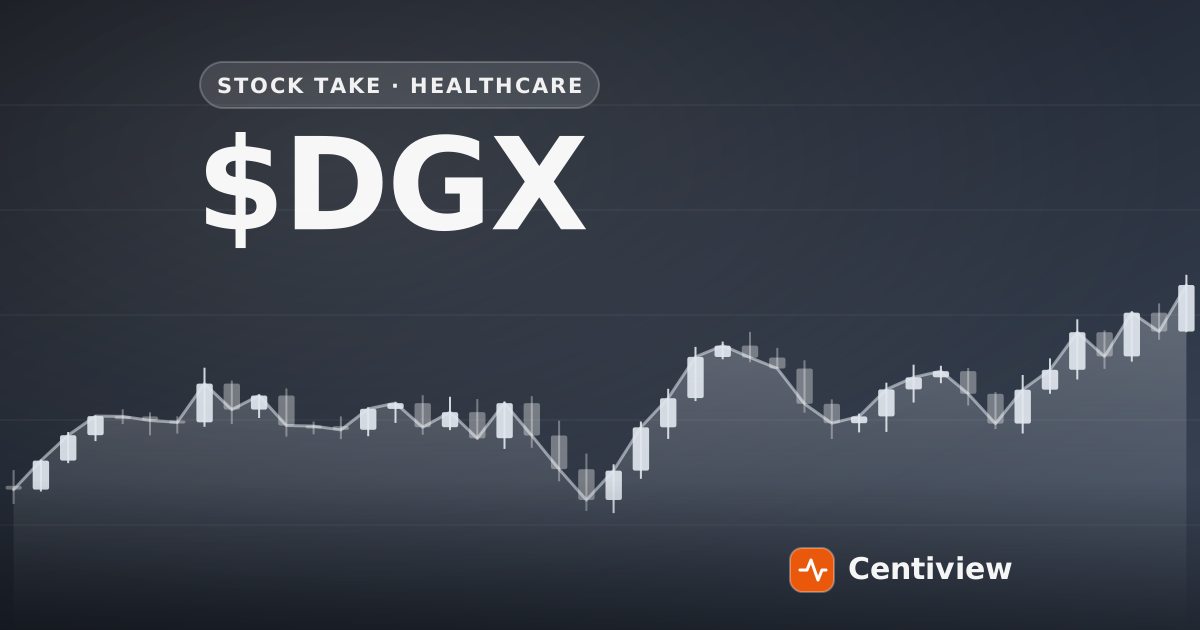
Quest Diagnostics, the largest US network of medical testing laboratories, reported third-quarter sales of $3,097m, up 10.0%, and adjusted profit per share of $3.00, up from $2.60. It raised its 2026 forecasts for sales and profit, and on the same day filed a separate notice saying an unauthorised party had accessed certain patient records in a system its clients use to order tests.
What happened
On 22 October 2026, Quest Diagnostics (DGX) published results for the three months to 30 September 2026 and filed them with the US Securities and Exchange Commission (SEC) on Form 8-K, the form used to report major events. Figures are in US dollars. Sales were $3,097m against $2,816m a year earlier. Profit per share under US accounting rules (GAAP) was $2.78, against $2.16. Adjusted profit per share, which leaves out items such as amortisation expense, restructuring and integration costs, was $3.00, against $2.60. The company also raised its full-year 2026 forecast, and said it had signed a deal to buy some outreach laboratory assets from a health system in the north-eastern US.
In a separate 8-K, also dated 22 October, Quest disclosed that on 21 October it learned of unauthorised access to its Quanum LSM system, which certain clients use to place test orders and look up results. The filing says the company started its incident-response procedures, told federal law enforcement and hired outside cybersecurity experts. It says the full scope is still under investigation, that an unauthorised party accessed certain patient records, and that the incident has not materially disrupted operations or its ability to serve patients. It gives no estimate of cost and does not say how many people are affected.
The numbers, explained
Sales rose $281m (3,097 minus 2,816), or 10.0% (281 / 2,816). The main business, Diagnostic Information Services, which is lab testing for doctors, hospitals and consumers, brought in $3,035m, up 10.2% from $2,755m. Growth came from volume, not price. Requisitions, the individual test orders sent to Quest, rose 14.5% (14.4% excluding acquisitions), while revenue per requisition fell 4.2%. Multiplying the two (1.145 x 0.958 = 1.097) gives roughly 9.7% growth, close to the reported figure. Revenue per order can fall when the mix shifts towards cheaper tests or lower-priced customers, so more orders at a lower average price can still add up to higher sales.
Profit grew faster than sales. Reported operating income, profit from running the business before interest and tax, was $479m against $386m, a margin of 15.5% of sales (479 / 3,097) against 13.7% (386 / 2,816). Adjusted operating income was $517m against $458m, a margin of 16.7%. Net income attributable to Quest was $312m reported (up from $245m) and $338m adjusted (up from $296m). Adjusted profit per share rose $0.40, or 15.4% (0.40 / 2.60). Cash from operations was $611m against $563m, up $48m, while spending on equipment and buildings rose $22m to $166m. At 30 September cash was $797m and total debt $5,550m, down from $5,671m at 31 December 2025.
Why it matters
Quest earns money by being paid for each test it runs, mostly from health insurers, government programmes and hospitals that outsource lab work. Many diagnoses and treatment decisions start with a lab result, so test volume is a gauge of how much healthcare people are using. The company credited strength across physician, hospital and consumer channels and productivity gains from automation and AI. Its nine-month requisitions are up 12.9% and sales up 9.8%, to $9,035m from $8,229m, so the third quarter continued a run rather than being a one-off. Falling revenue per order is worth watching: it means growth depends on volume and cost control.
The forecast change, which is the company's own view and not a fact, lifts 2026 sales to $12.065bn to $12.105bn from $11.95bn to $12.05bn, and adjusted profit per share to $11.25 to $11.35 from $11.05 to $11.25. Our arithmetic: the midpoints rise by $85m and $0.15. Taking away nine-month adjusted profit per share of $8.62 implies roughly $2.68 for the final quarter, below the $3.00 just reported. Investing.com reports the results beat analyst averages of about $2.87 per share and $3.05bn of sales, and that shares fell 6.8% after the announcement; it gives no reason, and we do not link the fall to either filing. The security incident matters because lab records are sensitive health data and the company lists its impact among the risks to future results.
What to watch next
Quest says it will hold its 2027 Investor Day on 25 March 2027 at the New York Stock Exchange. It plans to make a test panel of more than 50 biomarkers available to Apple Health users in the US later in 2026, and still expects to deploy Epic software in its first lab under Project Nova in the autumn of 2027. On the incident, further company disclosures on its scope, any notifications to patients or regulators, and any cost estimate are the facts to follow; none has been published yet. We have not confirmed a date for fourth-quarter results, so we do not state one.
- Requisition: a doctor's or consumer's order for lab tests
- Adjusted profit: profit excluding items the company chooses to list
- Operating margin: operating income as a share of sales
- Unauthorised access: someone getting into a system without permission
Sources
More on Quest Diagnostics (DGX) · Healthcare takes
For information only. Not financial advice. See our disclaimer and editorial standards. Spotted an error? Tell us.