Abbott (ABT): plans to spin off its $8.5bn Nutrition business as Q3 adjusted profit per share rises 9% to $1.42
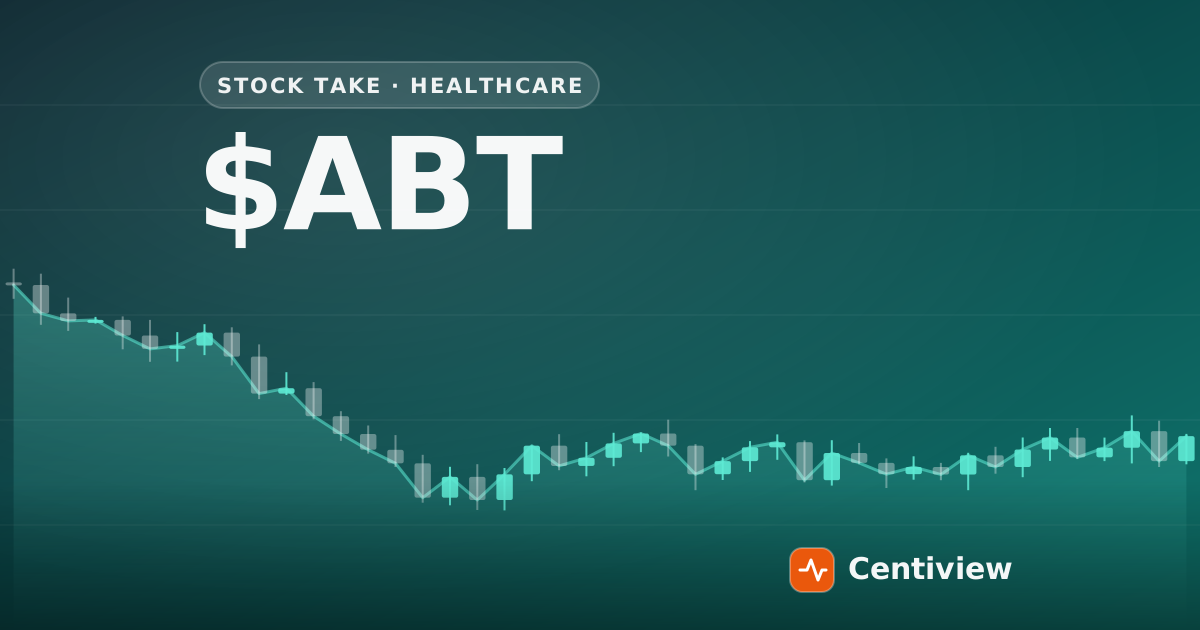
Abbott, the maker of medical devices, diagnostic tests, generic medicines and infant formula, said on 21 October 2026 that it intends to separate its Nutrition business into its own listed company by the end of 2027. The same day it reported third-quarter sales of $13.0bn, up 14.5%, and adjusted profit per share of $1.42, in line with analysts' expectations.
What happened
On 21 October 2026 Abbott made two announcements. The first, in a release filed with the US Securities and Exchange Commission (SEC), was that it plans to separate its global Nutrition business, whose brands include Similac, PediaSure, Pedialyte, Glucerna and Ensure, into an independent, publicly traded company. The method is a tax-free distribution, meaning Abbott shareholders would receive shares in the new company without a tax charge arising on the distribution itself. The new company would have about $8.5bn of annual sales, about 16,000 employees and 14 manufacturing sites. Abbott would keep about $42bn of annual sales and about 106,000 employees. The second announcement was its third-quarter results.
The company says completion is targeted by the end of 2027 and is subject to customary conditions, including regulatory approvals, an effective Form 10 (the registration document a company files with the SEC to list new shares), and final approval from Abbott's board. Daniel Salvadori, currently a group president at Abbott, would become chief executive of the Nutrition company. Abbott says the combined dividend from the two companies is expected to equal Abbott's dividend at the time of separation, and that the plan does not change its 2026 guidance. It also expects one-time charges before the separation, which it has not yet quantified.
The numbers, explained
Third-quarter sales were $13,013m, against $11,369m a year earlier. That is a rise of $1,644m, or 14.5% (1,644 / 11,369), as reported. Most of the jump came from the March 2026 purchase of Exact Sciences, a cancer-diagnostics company. Stripping out currency moves and the sales of Exact Sciences before Abbott owned it, Abbott's "comparable" growth, a like-for-like measure, was 7.0%. The gap shows why the headline number overstates underlying growth: Diagnostics sales rose 46.7% as reported, to $3,305m, but only 6.4% on a comparable basis. Medical Devices sales were $5,826m (up 6.9%, or 7.8% comparable), Established Pharmaceuticals $1,614m (up 6.8%, or 8.4% comparable) and Nutrition $2,262m.
Nutrition sales of $2,262m compare with $2,153m a year ago, a rise of 5.1% (109 / 2,153), or 4.9% comparable. That is notable because Nutrition had been the weak spot this year, with reported sales falling 6.0% in the first quarter and 3.1% in the second, according to Abbott's earlier releases. Nutrition made up about 17.4% of third-quarter sales (2,262 / 13,013). Profit tells a more complicated story. Under US accounting rules (GAAP), diluted earnings per share, profit divided by all shares including those that could be created from options, were $0.53, down from $0.94, a fall of 43.6% (0.41 / 0.94). Abbott's adjusted figure, which removes items such as the amortisation of acquired intangible assets (spreading the cost of acquired brands and technology over time), was $1.42, up from $1.30, or 9.2% (0.12 / 1.30).
The bridge between the two is in the release: $0.53 GAAP plus $0.89 of specified items equals $1.42. Those items totalled $1,689m before tax: $841m of intangible amortisation, about $670m of legal settlements and $178m of other net expenses (841 + 670 + 178 = 1,689). After tax, adjusted net earnings were $2,477m against GAAP net earnings of $920m. Adjusted gross profit, sales minus the direct cost of making products, was $7,448m, or 57.2% of sales, against $6,344m, or 55.8%, a year earlier (our working). Adjusted measures are the company's own and are not GAAP. Analysts' consensus, a third-party figure reported by MarketBeat, was $1.42 for profit per share and $12.99bn for sales, so results were in line on profit and marginally ahead on sales.
Why it matters
Abbott earns money in four ways: it sells medical devices (such as heart-rhythm and diabetes-monitoring products), diagnostic tests and instruments, established medicines sold mainly outside the US, and nutrition products such as infant formula and adult drinks. Nutrition is the most consumer-facing and the most exposed to price competition and to changes in birth rates and purchasing, while the other three sell to hospitals, laboratories and health systems. Abbott's own stated reasoning is that separation lets each company direct its resources to its own market, and that the remaining Abbott would have faster sales growth and a wider margin. Those are the company's claims, not established outcomes.
For investors the separation changes what they own rather than what the business earns on day one. A shareholder would hold a stake in two companies instead of one, each valued on its own record. For customers there is no announced change to products or brands. For rivals in medical technology, a more focused Abbott with about $42bn in sales remains a large competitor; in infant and adult nutrition, a standalone company with about $8.5bn in sales would compete as an independent business. Abbott has done this before: in 2013 it separated its research-based pharmaceuticals business into AbbVie. Share-price reaction on the day was reported as lower, but sources differed on the size, so we do not state a figure.
What to watch next
Several dated or defined steps follow. Abbott's guidance for the fourth quarter is adjusted earnings per share of $1.62 to $1.67, and for the full year $5.50 to $5.55, a range narrowed around an unchanged midpoint of $5.525, with comparable sales growth of about 6.0%. These are the company's forecasts, not facts. Abbott says it will issue 2027 guidance in January 2027, and it must file a Form 10 for the Nutrition company before the separation can proceed. The company has also said it will quantify the one-time separation charges later. It has not given a date for fourth-quarter results in the release we read, so we do not state one.
- Comparable sales growth: growth excluding currency moves and, here, Exact Sciences sales before it was acquired
- Adjusted EPS: Abbott's own profit-per-share measure, excluding items such as amortisation and legal settlements; not a GAAP measure
- Spin-off (tax-free distribution): giving existing shareholders shares in a new, separately listed company
- Form 10: the SEC registration document needed to list the new company's shares
Sources
- Abbott Q3 2026 earnings release, Form 8-K Exhibit 99.1 (SEC)
- Abbott announces intention to separate its Nutrition business, Form 8-K Exhibit 99.1 (SEC)
- Abbott beats revenue estimates, shares slide amid planned nutrition unit spinoff (Investing.com)
- Abbott Laboratories issues earnings results, hits estimates (MarketBeat)
- Abbott Q3 2025 results release (prior-year figures)
More on Abbott (ABT) · Healthcare takes
For information only. Not financial advice. See our disclaimer and editorial standards. Spotted an error? Tell us.