Tyson Foods (TSN): Q4 profit per share falls 47% as beef losses deepen, and it forecasts lower 2027 sales
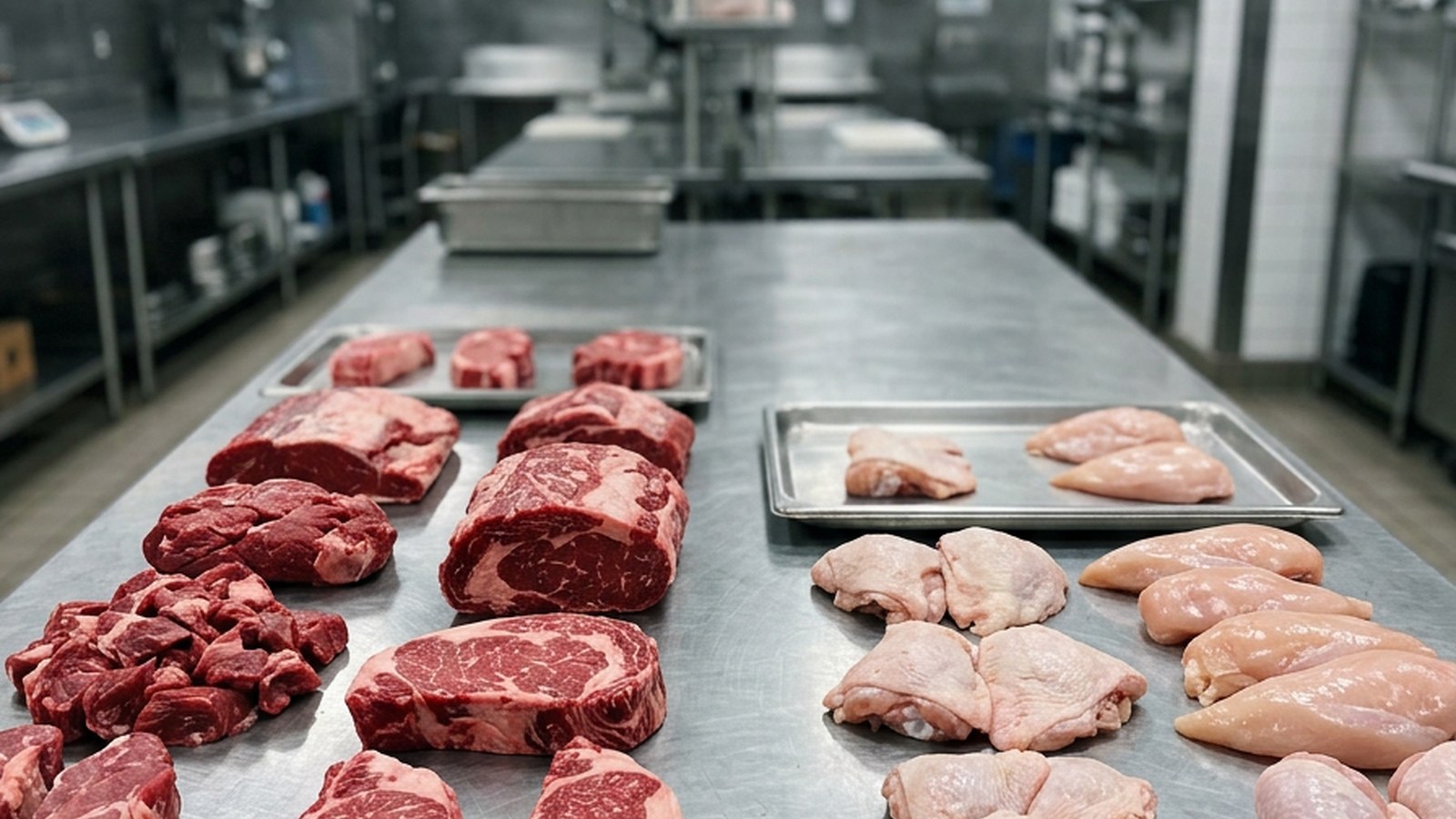
Tyson Foods, the US meat company behind beef, chicken and pork brands, said fourth-quarter sales rose 5.2% to $14.59bn, but only because the quarter had an extra week; its adjusted profit per share fell 47% to $0.61. The beef business, squeezed by the smallest US cattle supply in decades, lost $171m on an adjusted basis, and Tyson now expects fiscal 2027 sales to fall 3.5% to 5.5%.
What happened
Tyson published results on 16 November 2026 for its fourth quarter, the 14 weeks to 3 October 2026, in a filing with the US Securities and Exchange Commission. All figures are in US dollars. Sales were $14,585 million, against $13,860 million a year earlier. Under standard accounting rules (GAAP), the company made an operating profit of just $1 million, down from $158 million, and a net loss of $74 million, or 22 cents per share, against a profit of 13 cents a year earlier. Most of that gap came from restructuring charges, the costs of reshaping its beef plant network, and from money set aside for legal claims. The company raised its quarterly dividend by 2% and gave its first forecast for fiscal 2027, which runs to early October 2027.
The numbers, explained
The headline sales rise flatters the quarter. Fiscal 2026 had 53 weeks, and the extra week fell in this quarter, so it ran 14 weeks against 13 a year ago. The company says that once the extra week and the legal accruals (money set aside for lawsuits, recorded as a cut to sales) are removed from both years, sales actually fell 4.0%. Adjusted operating profit, which strips out the extra week, the restructuring charges and other one-off items, fell 41% to $361 million from $608 million: $361m divided by $608m is 0.594, a drop of 40.6%. Adjusted profit per share fell from $1.15 to $0.61, a 47.0% fall by our working.
The business units tell the real story. Beef lost $171 million on an adjusted basis, more than three times the $52 million loss a year earlier; on the GAAP measure, which includes the restructuring costs, the loss was $514 million against $277 million. Chicken still made money, but its adjusted operating profit fell 30.8%, from $562 million to $389 million. Prepared Foods, which sells branded products such as bacon, sausages and ready meals, rose 15.5%, from $278 million to $321 million. For the full year, sales rose 3.6% to $56.42 billion ($56,419m against $54,441m), adjusted operating profit fell 13.6% to $1.98 billion, and adjusted profit per share fell 16.5%, from $4.12 to $3.44. Free cash flow, the cash left after running the business and paying for new equipment, was $1.66 billion, up $486 million.
Why it matters
Tyson makes money by turning live animals into meat and food products, then selling them to supermarkets, restaurant chains and food service companies. Its profit depends on the gap between what it pays farmers for animals and what it can charge customers. In beef, that gap has collapsed: years of drought have left the US cattle herd at its lowest level in about 75 years, so cattle are scarce and expensive, while beef processors compete for too few animals. Tyson is responding by restructuring its beef network, which means handling fewer cattle; that is why it expects lower sales next year. Chicken and prepared foods have carried the group, which shows the value of selling several kinds of protein. Rival beef processors buy from the same shrinking herd, so the shortage affects the whole sector, and customers such as supermarkets and restaurant chains face higher costs for beef.
What to watch next
These are the company's own forecasts, not results. For fiscal 2027, Tyson expects sales to fall 3.5% to 5.5%; applied to this year's $56.42 billion, that is roughly $53.3 billion to $54.4 billion, our calculation. It expects total adjusted operating profit of $1.7 billion to $2.15 billion, against $1.98 billion this year, with beef between a $300 million loss and a $100 million profit, chicken at $1.3 billion to $1.6 billion, prepared foods at $1.25 billion to $1.4 billion and pork at $75 million to $175 million. It expects free cash flow of $0.8 billion to $1.3 billion and spending on equipment and buildings of $1.1 billion to $1.4 billion. The higher dividend of 52 cents per Class A share is payable on 15 December 2026 to shareholders on the register on 1 December 2026. Tyson has not yet published the date of its next results.
- Adjusted operating profit: profit from day-to-day business, with one-off costs such as restructuring and legal accruals removed
- Restructuring charges: costs of closing or reshaping plants, such as write-downs and severance
- Free cash flow: the cash left after running costs and investment in equipment and buildings
Sources
- Tyson Foods Q4 and fiscal 2026 results, Form 8-K exhibit 99.1 (Tyson Foods via SEC, primary)
- Tyson Foods Q4 profit falls 47% as beef losses deepen (Crypto Briefing)
- Tyson Foods expects sales to fall in fiscal 2027 as cattle shortages keep its beef unit in the red (MLQ.ai)
- Tyson Foods revenue rises 5.2% to $14.59 billion (Grafa)
More on Tyson Foods (TSN) · Consumer & Retail takes
For information only. Not financial advice. See our disclaimer and editorial standards. Spotted an error? Tell us.