Texas Instruments (TXN): Q3 sales rise 28% and profit rises 78% as demand for its everyday chips recovers
Texas Instruments, the US company that makes the low-cost chips that manage power and signals in cars, factories and data centres, reported third-quarter sales of $6.06bn, up 28% on a year earlier. Profit rose 78% to $2.43bn, and the company's own forecast for the next quarter came in above what analysts had expected.
What happened
On 21 October 2026, after US markets closed, Texas Instruments (TI) published its results for the three months to 30 September 2026 and filed them with the US Securities and Exchange Commission (SEC) on Form 8-K, the form used to report major events. All figures here are in US dollars and follow US accounting rules (GAAP), unless we say otherwise. Sales were $6.055bn and profit, which the company calls net income, was $2.425bn. Profit per share was $2.62. TI said revenue grew in each of its main markets: industrial, automotive and data centres. It also listed personal electronics and communications equipment as markets it serves. The chief executive, Haviv Ilan, said in the release that revenue was up 11% on the previous quarter and 28% on a year earlier.
The company also gave its forecast for the fourth quarter: sales of $5.80bn to $6.30bn and profit per share of $2.45 to $2.79. Independent coverage from Investing.com put the average analyst expectation for Q3 at about $5.9bn of sales and about $2.42 of profit per share, and for Q4 at about $5.75bn of sales. Those expectation figures differ slightly between data providers (StockStory quoted $5.90bn and $2.43), so treat them as approximate. They are analysts' estimates, not facts reported by the company, and both sets of figures came in above them.
The numbers, explained
Start with sales. Sales of $6,055m compare with $4,742m a year earlier: 6,055 / 4,742 = 1.277, so sales rose 27.7%, which the company rounds to 28%. Against the previous quarter, which TIKR reported as $5.46bn, the rise is 6,055 / 5,460 = 1.109, or about 11%. TI's own forecast in July had been $5.65bn to $6.15bn, so the result landed near the top of that range. Profit per share of $2.62 was above the top of the $2.23 to $2.57 range it gave for the quarter, and it included a one-cent reduction that the company had not included in its original forecast.
Profit grew much faster than sales, which is the key point. Operating profit, the profit from running the business before interest and tax, rose from $1,663m to $2,874m, up 73%. Dividing by sales gives an operating margin, the share of each dollar of sales left as operating profit, of 47.5% (2,874 / 6,055), up from 35.1% (1,663 / 4,742) a year ago. Net income rose from $1,364m to $2,425m, up 78% (2,425 / 1,364 = 1.778). Profit per share rose 77%, from $1.48 to $2.62, slightly less than total profit because there were about 921m shares against 914m. Gross profit, sales minus the direct cost of making the chips, was $3,887m, or 64.2% of sales, compared with $2,723m, or 57.4%, a year ago. That is our own calculation.
By business, Analog chips (which handle real-world signals such as power and sound) had sales of $4,911m, up 32%, and operating profit of $2,505m, up 69%. Embedded Processing (small computers on a chip) had sales of $858m, up 21%, and operating profit of $227m, which is more than double the $108m a year ago. The Other category had sales of $286m, down 6%. The three add up to the $6,055m total. Cash also grew: cash from operations was $3,419m against $2,190m a year ago, and spending on equipment and buildings (capex) was $463m against $1,197m, a fall of 61%. Free cash flow, a non-GAAP figure TI defines as operating cash flow less capex plus US government CHIPS Act incentive proceeds, was $2,956m in the quarter and $8,422m over the last 12 months.
Why it matters
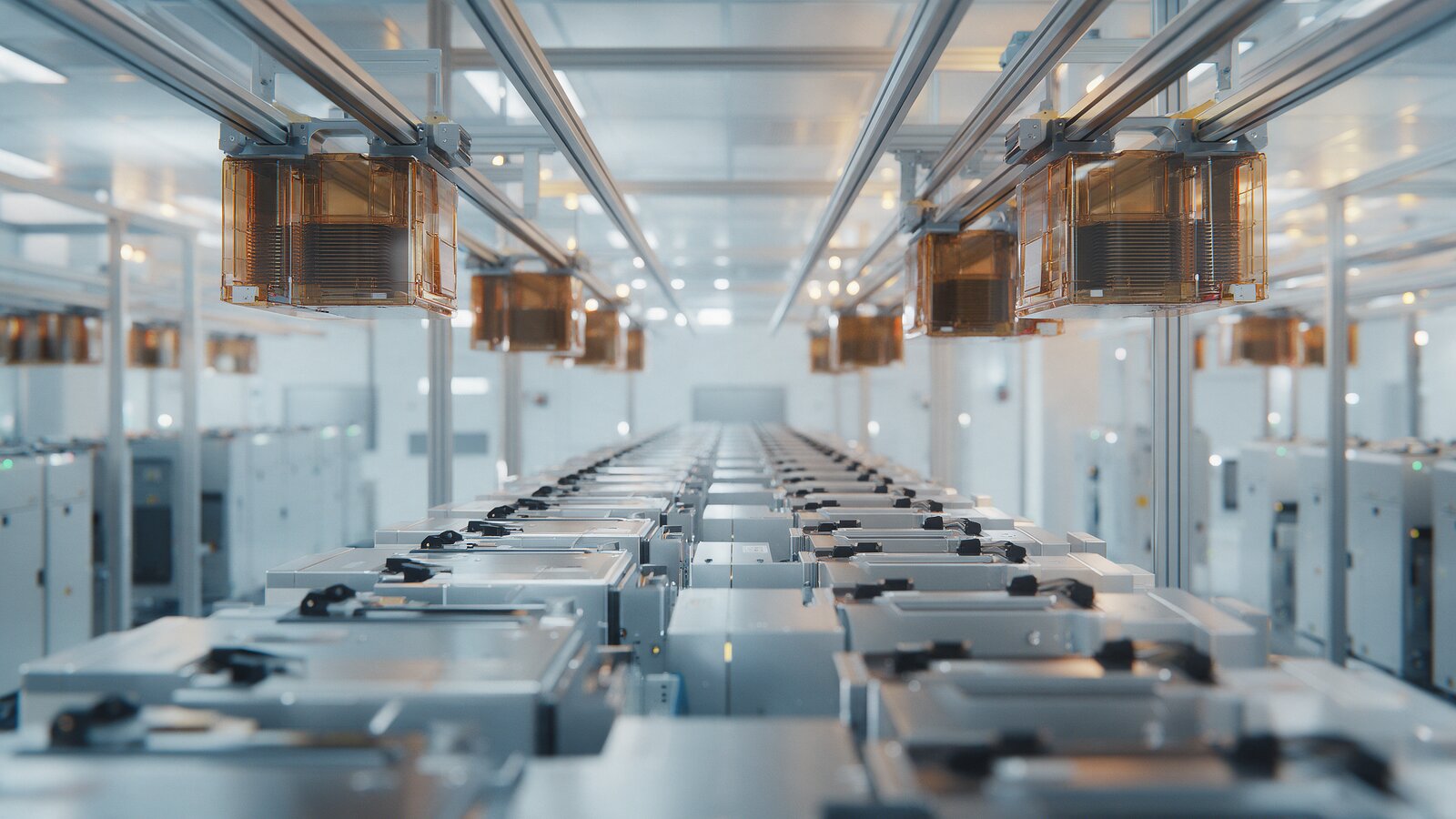
TI earns its money by selling large volumes of relatively simple, long-lived chips to thousands of customers, from carmakers to factory-equipment makers. Because it owns its factories, a lot of its costs are fixed. When sales rise, much of the extra money falls through to profit, which is why a 28% rise in sales produced a 73% rise in operating profit. This quarter shows that effect at work, with growth reported in industrial, car and data-centre demand.
The cash figures show a second change. TI spent heavily on new factories, including 300mm production (chips made on larger 300-millimetre silicon wafers, which lowers the cost per chip), and that spending has now fallen: $2,578m over the last 12 months against $4,817m a year earlier. With spending down and profit up, free cash flow over 12 months was 40.6% of sales, compared with 14.0% a year earlier, according to the release. TI returned $5.81bn to shareholders over the same period, almost all of it dividends: it declared $1.42 a share for the quarter, up from $1.36 (a rise of about 4.4%), while share buybacks fell 61% to $636m over 12 months. For rivals and customers, this reads as a recovery in everyday chip demand rather than only in the high-profile artificial-intelligence chips.
What to watch next
TI's full quarterly report, the Form 10-Q, will carry more detail on costs, stock levels and cash than the press release. The company's own fourth-quarter forecast, $5.80bn to $6.30bn of sales, will be tested when it reports fourth-quarter and full-year results. We have not seen a confirmed date for that release, so we do not state one. The release itself flags demand in industrial and automotive markets as a risk factor in its forward-looking statements, so those two markets are the ones to follow in the next set of figures. We leave out the share-price reaction because the sources we read gave an unclear picture.
- Operating margin: operating profit as a share of sales
- Free cash flow: cash left after running costs and investment (TI's version also adds US CHIPS Act incentive cash)
- Analog chip: a chip that handles real-world signals such as power, sound and temperature
- Capex: spending on equipment and buildings
Sources
- Texas Instruments Q3 2026 results, Form 8-K Exhibit 99 (SEC, primary)
- TI reports third quarter 2026 financial results and shareholder returns (Stock Titan copy of press release)
- Texas Instruments beats quarterly estimates on robust chip demand, lifts outlook (Investing.com)
- Texas Instruments's Q3 sales top estimates (StockStory)
- Texas Instruments guided above seasonal after Q2 earnings (TIKR)
More on Texas Instruments (TXN) · Semiconductors takes
For information only. Not financial advice. See our disclaimer and editorial standards. Spotted an error? Tell us.